
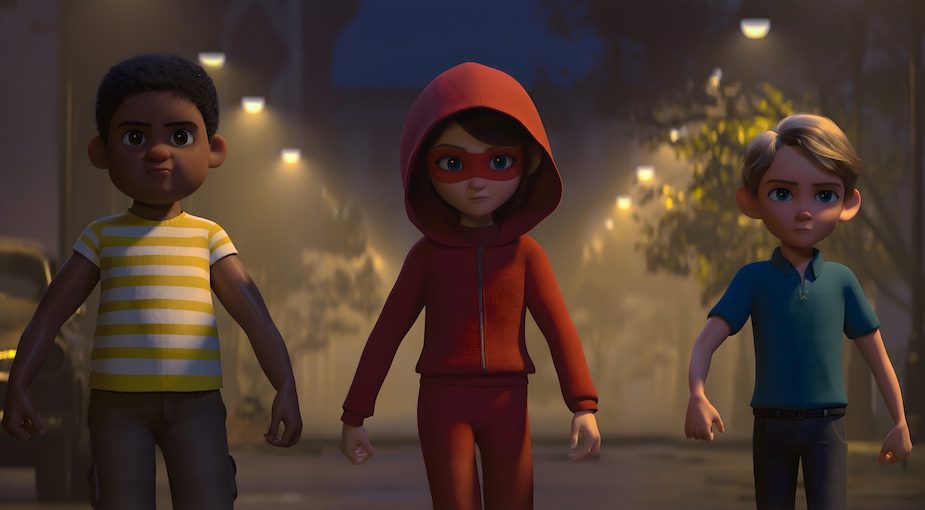
Handbok för superhjältar is the cinematic adaptation of the beloved Swedish book series, bringing a modern superhero story to the big screen through advanced motion capture and real-time rendering technology. The film was warmly received by audiences and celebrated for its bold visual language, emotional storytelling, and technical ambition.
Behind the scenes, the production represented one of Sweden’s most advanced Unreal Engine–driven feature film pipelines to date.
The film was produced by Stiller Studios in Lidingö, Sweden, using a fully performance-capture–driven workflow.
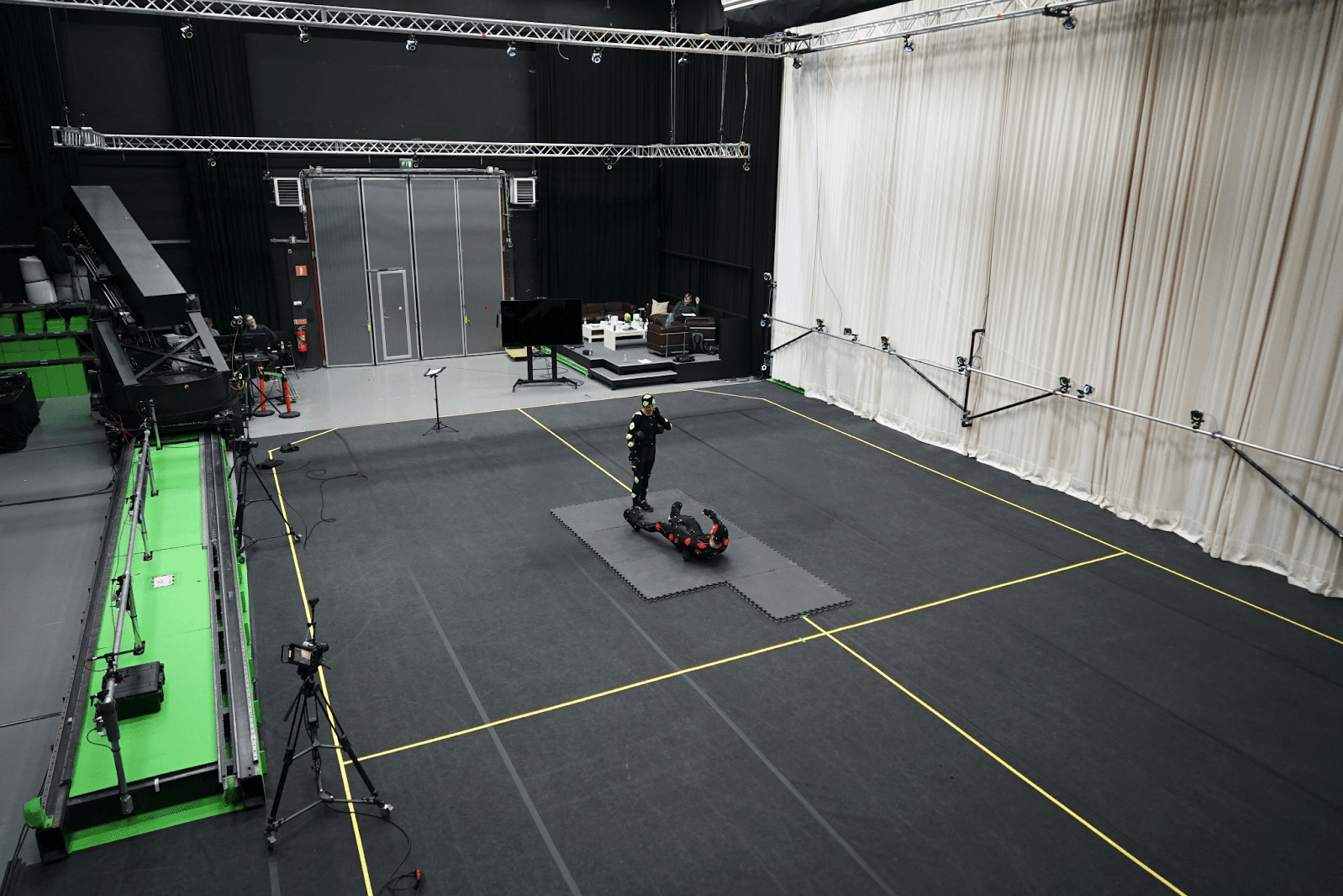
• Full performance capture using the OptiTrack Motive setup at Stiller Studios, including Facial capture and Rokoko hand capture
• Editorial completed, then re-conformed back into Unreal Engine 5
• Selected takes cleaned in Motive → exported as FBX → re-imported into Unreal
• Animation, FX, lighting and set dressing in Unreal Engine, Maya and other DCCs
• Final shots rendered using Unreal Engine 5 Path Tracer via Movie Render Graph (MRG)
• Output: 2K EXR sequences and Quicktime ProRes422HQ proxies
• Denoise with NeatVideo
• Compositing in Nuke • Grading and finishing in DaVinci Resolve
• Final mastering and online by FyraK Media
This was not a conventional offline render workflow. It was a hybrid, high-complexity Unreal production with nested level sequences, sub-sequences with handles, and path-traced cinematic output.


Stiller Studios had already relied on accsyn for years as the backbone for:
• Secure file delivery
• Large-folder transfers
• Site-to-site synchronization
• Production collaboration, ftrack integrations
High Definition Render, the company behind accsyn, had also historically supported Stiller’s Python-driven motion-control pipeline giving deep familiarity with their infrastructure and workflow DNA. This trust became crucial when the production hit its biggest bottleneck.
1. No Existing Render Farm
Stiller did not have an Unreal-capable render farm for large-scale path traced cinematic output.
2. Deadline 10 Could Not Handle the Complexity
They explored Deadline 10, but their setup proved too complex:
• Level Sequences referencing Sub-Level Sequences
• Shot handles
• Advanced Burn-in
• Intelligent log stream parsing and actioning
The configuration overhead became a risk to delivery!
3. Cross-Site Collaboration Required
Their animation partner, Qvisten Animation in Oslo, also has available GPU stations that needed to help out with final renders.
4. Deadline Pressure
The delivery schedule left no room for experimental infrastructure.
5. Cloud Scaling Needed
Stiller quickly onboarded GPU machines at Remangu in Frankfurt to scale capacity – but these needed to integrate seamlessly with the on-prem and Oslo environments.
Stiller desperatly required a tailored render orchestration system!
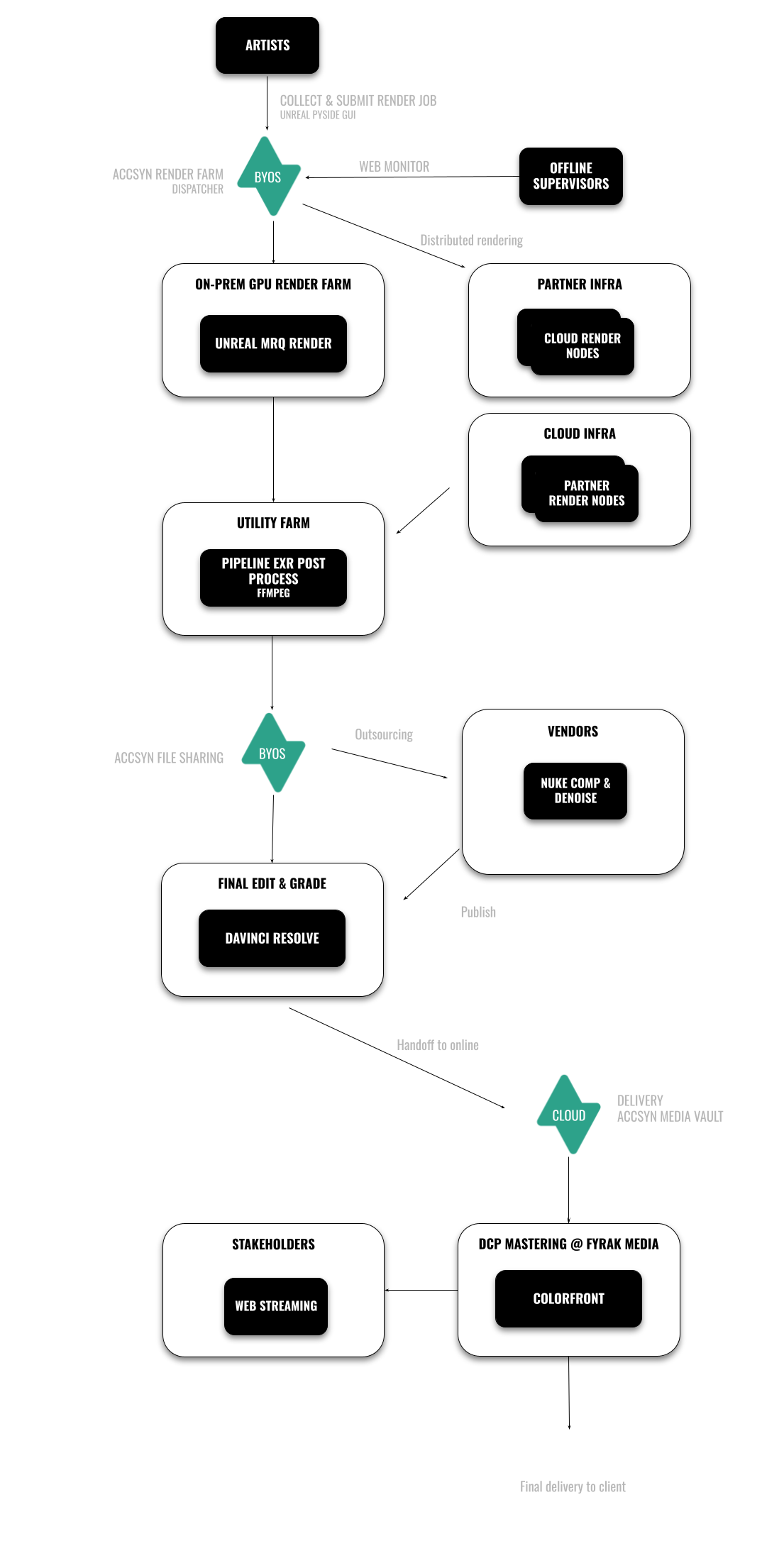
Instead of deploying a traditional render manager, accsyn was extended into a distributed Unreal-focused render orchestration system.
Deployment:
• accsyn installed on all RTX 5090-equipped workstations
• Machines configured for maximized desktop rendering stability
• Automatic minimization of other applications during render
• Realtime monitoring of render times and GPU/CPU/Memory usage.
Two dedicated Python engines were written:
Unreal Editor MRQ Engine – because Unreal lacked full command-line rendering for their use case:
• The engine launched Unreal Editor
• Primed the correct Level Sequence & Camera Sequence
• Executed Movie Render Graph path-traced jobs
• Injected burn-ins and metadata dynamically
• Monitored GPU and VRAM usage in realtime.
StillerPipe Engine for post-processing automatation • EXR validation per frame • Camera reng into full sequence naming conventions • QuickTime preview transcode • Automatic upload to ftrack • Artist comments attached to preview deliverables
• Each EXR frame converted to JPEG • Live preview available in the accsyn web portal • Artists could Q/A frames directly on mobile devices This dramatically reduced feedback latency.
Because accsyn natively supports site-to-site rendering:
Jobs dispatched across –
• Stiller Studios (Sweden)
• Qvisten Animation (Oslo)
• Remangu GPU nodes (Frankfurt)
accsyn handled:
• Asset pulls via Perforce
• Frame synchronization
• Return of final EXR sequences to Stiller main storage
• Queue dispatch
• Failure handling
No external queue manager required.
The system ran under feature-film deadline conditions.
• No queue collapse
• No dispatch instability
• No frame corruption
• No sync inconsistencies
The accsyn render orchestration layer proved stable, deterministic and production-ready.
After the final renders were finished, grading and mastering were carried out with the assistance of the accsyn platform:
• Compositing were outsourced to external vendors. With accsyn File Sharing acting as a standard FTP, sending and receiving images were hassle free due to the resilient and fast ASC (accsyn copy) network file transfer protocol.
• Upload of the final movie to FyraK Media, who handled the DCP mastering, went through the accsyn Delivery subsystem.
• Deliverables transcoding and streaming to stakeholders were carried out at FyraK’s and the accsyn Media Vault.
Throughout the entire production, accsyn proved its worth as the stable backbone of data I/O and processing.
HDR/accsyn joined us on short notice during production of a fully animated feature film, where we were facing major Unreal render challenges.
They implemented a scalable render farm using our in-house machines and cloud resources, powered by accsyn, which significantly reduced render times and stabilized our pipeline.
Being able to track render times and optimize our scenes was critical in keeping our delivery on schedule.
accsyn also enabled secure, seamless transfer of large files to our partners.